
Greenfield Directory Years on Record
Greenfield city directory holdings are a set of dated snapshots, not an annual roll. The Indiana State Library's Hancock County holdings sheet identifies the volumes and publishers below. Hancock County Public Library supplies the main local research route, while the 1922 volume is also freely scanned online. Each volume needs its own geography check because some cover the city, some cover the full county, and the late Polk books span four counties.
| Directory run | Years held | Keeper | How to consult it |
|---|---|---|---|
| Greenfield City Directory Co. | 1905 | State Library and Hancock holdings | Check the catalog or local-history shelf |
| Prairie Farmer's | 1921 | Library and State Library | County and rural coverage |
| W.H. Hoffman city/county directory | 1922 | Internet Archive and library | Free scan plus physical copy |
| Directory Service, Johnson's, and listed local volumes | 1955, 1961, 1963, 1968, 1973, 1975, 1979, 1981, 1999 | Hancock/State Library holdings | Inspect each volume in person |
| Polk four-county edition | 2012, 2015 | Library and State Library | Hancock, Henry, Rush, and Decatur coverage |
Do not fill the unlisted years by guesswork. No official source identifies one continuous publisher run or the last printed Greenfield edition. The 1921 agricultural volume is not the same product as a city-only book, and the 2012 and 2015 Polk editions need a city-versus-county check. Call the library before a long trip if one year matters.
Greenfield Directory Help at HCPL
The Hancock County Public Library Local History/Genealogy Room is at the main library, 900 W McKenzie Road. It is open Monday through Thursday from 9 a.m. to 8 p.m., Friday from 9 a.m. to 6 p.m., Saturday from 9 a.m. to 5 p.m., and Sunday from 1 to 4 p.m. Call 317-462-5141 or use the library's Book a Librarian service to ask about a volume, reader, or index before visiting.
The room joins city directories with newspaper microfilm, maps, tax microfilm, cemetery books, court and probate volumes, census tools, Ancestry Library Edition, and HeritageQuest. Some licensed databases may work only inside the library. Staff can identify a shelf run or a cited source, but the room is not a live database of current residents.
Bring a short list of names, spellings, dates, and streets. Ask whether the needed book is on a shelf, on microfilm, or available through a licensed database. When no remote image exists, note the volume title and page, then request staff guidance or plan an in-person visit. This keeps a physical holding from being mistaken for a searchable online index.
The Indiana State Library also publishes a Hancock County research guide. Its county indexes and book references are useful when the local shelf lacks the year or record type needed.
Decode Greenfield's 1922 Directory
The digitized W.H. Hoffman 1922 city and county directory includes a Greenfield section, county material, and a street guide. Its preface says names came from canvassing and earlier issues. It also warns that spelling can vary. That warning matters when a typed search finds nothing.
The scan gives direct access to printed pages, but OCR can confuse initials, digits, and short street forms. Confirm every hit on the page image and use the street guide to check whether an address fits the printed grid.
| Name | Surname and given name, sometimes initials or a variant spelling |
|---|---|
| Household note | A spouse or other note may appear in parentheses |
| Work line | A trade, role, or business may be listed |
| Residence | The letter r marks a residence line, followed by an abbreviated address |
| Street context | The street guide helps place the address within the period city grid |
- Criss-cross directory
- A directory arranged by street or address rather than only by surname. No exact Greenfield reverse-run years were verified, so inspect each book.
- Householder index
- An address or household finding aid within some directory formats. Its presence must be checked volume by volume.
- Abbreviation key
- The page that explains the publisher's shortened street, residence, and household marks. Save it before transcribing entries.
Greenfield Directory Boundaries Shift
A Greenfield city directory entry must be tagged by the volume's actual scope. Prairie Farmer's 1921 directory reaches city and county agricultural households. Hoffman's 1922 book combines a city section, street guide, and county section. Polk's 2012 and 2015 editions join Hancock with Henry, Rush, and Decatur counties. A name in any of those books does not by itself prove residence inside Greenfield's incorporated line.
Statewide business and gazetteer series can fill another gap. The Indiana State Library directory guide lists broad Indiana series from the nineteenth and early twentieth centuries. Those books may identify a Greenfield firm or official even when no local household volume survives for that year.
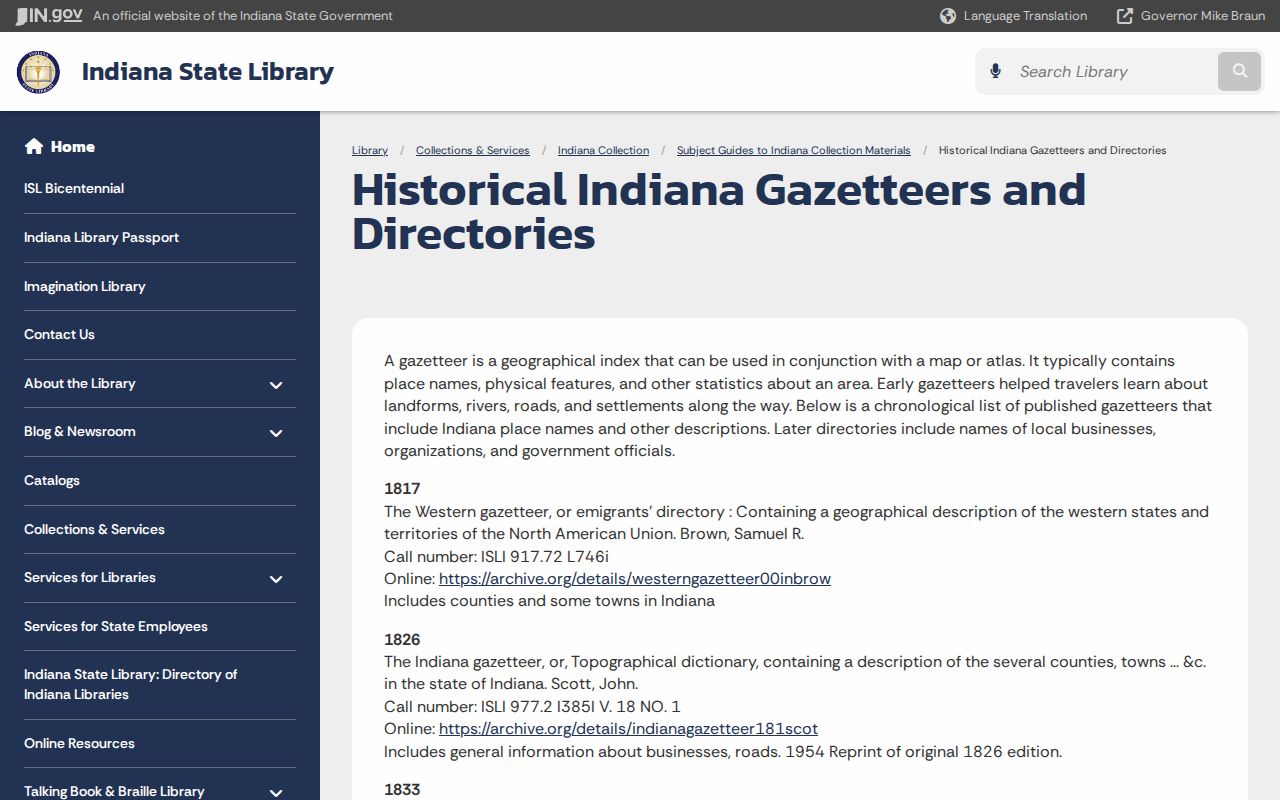
The statewide collection is best used as a bridge. Return to the local volume, map, or county record before assigning the person to one Greenfield address.
Maps Clarify Greenfield Directory Addresses
Period maps can resolve a shortened street name, rural route, or subdivision reference. State Library holdings include Greenfield city maps for 1955, 1961, 1963, and 1968, plus a 1973 Johnson's map and street guide. Sanborn fire-insurance coverage exists for 1886, 1892, 1895, 1900, 1906, 1914, 1927, and a 1927 to 1949 update run.
Sanborn sheets show building footprints, use, materials, and street context. They do not identify occupants. No verified Greenfield street-renumbering year was found, so an address mismatch should be bridged with a directory page, printed street guide, plat, legal description, and period map. The modern parcel number and legal description are safer links than a guessed renumbering story.
Greenfield's National Road and US 40 setting, downtown Main and State grid, Brandywine references, and rural routes appear across sources with different labels. Copy the wording used in each source before trying to normalize it. A city map may settle street orientation, while a plat or deed settles the land description. Neither source should be used to rewrite the directory entry.
Greenfield Names Beyond Directories
The WPA indexes preserved a strong pre-digital name bridge. Hancock County Public Library lists birth, death, and marriage indexes focused on 1882 through 1920, along with the Hancock County Index of Names of Persons and Firms. That names-and-firms book points to specified source volumes before 1940. It is a finding aid, not final proof.
Park Cemetery adds another local story. The city acquired an older cemetery site in 1868, and graves or markers were later moved to Park Cemetery amid gaps in early record keeping. When a city directory resident seems to vanish, compare cemetery books, obituary notices, church material, probate, and the city cemetery contact rather than relying on one database label.
Local newspapers widen the search: Hancock Democrat/Journal runs from 1860 to 1973, Hancock Republican from 1889 to 1973, and Daily Reporter from 1908 forward. Only an 1860 to 1876 local index was specifically noted, so later dates may require browsing microfilm or a licensed newspaper database.
Read a Greenfield Directory Entry
Read the whole printed line, not just the name returned by OCR. In the Hoffman volume, a parenthetical note may describe the household, a work line may name a trade or business, and r introduces the residence. That address is evidence that the publisher associated the person with a place during its canvass. It is not a deed or proof of ownership.
Photograph or save the title page, date, abbreviation key, entry page, and street-guide page. The full citation makes it possible to distinguish a city section from a county section. If a later volume contains an address-order feature, record that too, but do not assume every Greenfield book is a criss-cross directory.
Trace Families in Greenfield Directories
City directories can place a family between public census years, but Greenfield's shelf has long gaps. Start with a verified name, preserve initials and spouse notes, and treat each listed year as a separate observation. The 1890 census is largely lost, which makes directories, deeds, newspapers, and local indexes especially useful around that missing schedule.
- Find the first listed volume that contains the name. Save the exact spelling, household note, address, page, and directory scope.
- Check the next available year, not an assumed annual sequence. Note moves, new initials, spouse changes, and absences.
- Pair nearby directory years with the 1910, 1920, 1930, 1940, or other released census schedule.
- Use the street guide and period maps to test the old address. For modern address-keyed work, move to the Greenfield street records.
- Explain a disappearance with newspaper, cemetery, marriage, death, probate, or deed evidence. Absence alone does not show death or a move.
A careful timeline marks every gap. County formation in 1828, city incorporation in 1876, the earliest listed local directory in 1905, Hoffman in 1922, and the later scattered volumes are context, not proof about a household. Finish with the record held by the office or archive that best answers the remaining question.
For a family line, the end product should show the source and date behind each conclusion. A directory supports an association with a printed residence, a census supports a scheduled household, a deed supports a land transaction, and an obituary supports a reported life event. Agreement across those distinct records is stronger than repeating one unsourced online transcription.